Mitsubishi AC Repair in Glendale, CA
Bottom line first: Glendale Mitsubishi HVAC repairs Mitsubishi Electric AC and mini-split systems across Glendale, including Adams Hill and Downtown Glendale (ZIP 91205), reading the exact P, U, or E fault code and naming the failed part with a price lane before any work, so call (213) 755-3565 or book online to get it diagnosed right. Most repairs land within the same week.
Good to know
- Diagnostic-first: we pull the fault code from the LED, kumo cloud, or MHK2 before quoting.
- Service area: Glendale plus Adams Hill, Rossmoyne, Verdugo Woodlands, El Miradero (91201-91208).
- Equipment: M-Series MSZ/MUZ ductless, MXZ multi-zone, P-Series PUZ/PEAD/PVA.
- Diagnostic about $79-$200; capacitor/contactor $150-$450; leak + recharge $225-$1,500.
- Inverter or control board replacement $400-$2,000 depending on model.
- Hours: Weekdays 6am-8pm, emergency service on call; emergency on call for no-cool events.
- Independent; in-warranty units referred to Mitsubishi-authorized service first.
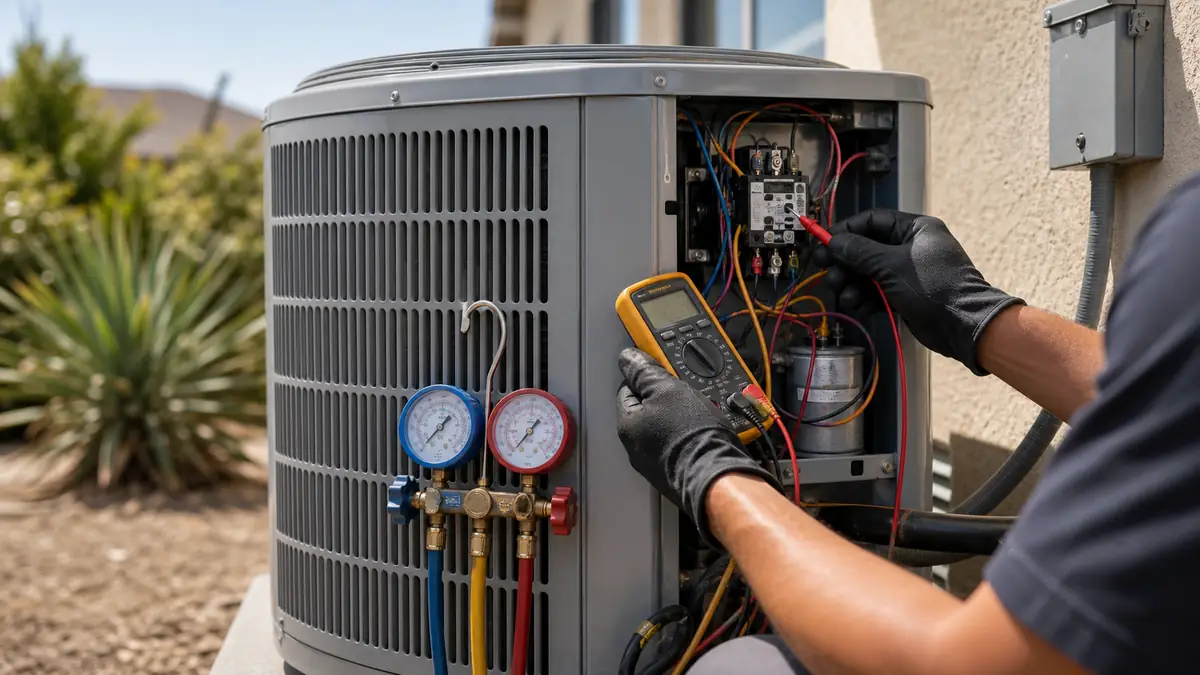
What usually breaks on a Mitsubishi AC in Glendale?
In Glendale's Climate Zone 9 heat - July highs near 89-94 F and 35-50 days a year over 90 F - the parts that fail are predictable. Capacitors weaken under repeated hard starts in the afternoon, condensate drains clog by late summer, and flare joints on ductless line sets weep refrigerant after years of thermal cycling. The chart below maps the symptom to a likely cause and a 2026 SoCal cost lane so you walk into the repair knowing roughly what it should run.
| Symptom | Likely cause / first check | Cost lane |
|---|---|---|
| Outdoor unit hums, fan or compressor won't spin | Run/start capacitor or pitted contactor (MUZ outdoor) | $150-$450 |
| Water under indoor head, unit trips, P4/P5 code | Clogged condensate drain, failed drain pump or float | $150-$450 |
| Weak cooling, frost on line set, P8 or U7 code | Refrigerant leak at flare joint, low charge, or LEV/EEV stuck | $225-$1,500 |
| Freeze trip and no cool, P6 code | Dirty filter or coil starving airflow; blower wheel fouled | $200-$600 |
| Outdoor unit trips on startup, U6 or UF code | Inverter PCB/IPM, compressor overcurrent, DC fan motor | $400-$3,500 |
| Trips on U2 high discharge temp on hot afternoons | Overheating compressor, low charge, or blocked condenser coil | $225-$3,500 by root cause |
| Intermittent shutdowns, E6/E7 comm code | Loose or corroded S1/S2/S3 inter-unit wiring or PCB | $150-$2,000 by part |
| Comfort drifts, airflow ignores the room, P1/P9 code | Room/coil thermistor or 3D i-see sensor (MSZ-FS) | $200-$600 |
How does a Mitsubishi AC repair actually go, step by step?
We work a Glendale repair the same way every time, and the sequence is what keeps your invoice tied to the part that actually failed rather than to whatever was easiest to reach. Mitsubishi makes that discipline easy: the system logs and flashes its own diagnostic code, so the visit opens with hard evidence instead of a hunch.
- Read the code at the source. We pull the P, U, or E code from the indoor unit's green operation LED blink pattern, the kumo cloud app, or the MHK2 / PAR controller. The code narrows the failure to a subsystem before any panel comes off.
- Confirm electrically and mechanically. We meter the dual-run capacitor against its rated microfarads, check the contactor contacts, and on the refrigerant side take suction and liquid pressures, superheat, and subcool. A U7 with high superheat confirms a low charge; a P8 with an odd pipe temperature points at a leak or a stuck LEV/EEV.
- Find the leak, not just the symptom. On low-charge calls we pressure-test or use an electronic detector at the flare joints - the usual ductless weep point - rather than topping off blind, which only postpones the failure.
- Repair or order. Capacitors, contactors, drain pumps, and thermistors finish the same visit off the truck. An inverter PCB, IPM, or compressor is ordered against your exact MSZ, MUZ, MXZ, or P-Series model number, with cost and lead time quoted before we leave.
- Recharge and verify. After a leak repair we evacuate and weigh in refrigerant to the nameplate charge, then retest superheat and subcool under load and confirm the stored code is cleared so the same fault does not resurface in the next heat spell.
Which Mitsubishi model families do you repair in Glendale?
The repair changes with the line, so we identify the family first. Across Glendale homes we see four groups, and what fails - and what it costs - differs between them.
- M-Series single-zone ductless (MSZ heads + MUZ condensers). The bulk of Glendale calls: MSZ-WR and MSZ-GL value heads, the MSZ-FS deluxe with its 3D i-see sensor, and matched MUZ-FS or MUZ-WR condensers. Typical faults are drain (P4/P5), freeze (P6), and flare leaks (P8/U7).
- M-Series multi-zone (MXZ and MXZ-SM SMART MULTI). One outdoor unit on several heads adds wiring and branch-box complexity, so comm faults (E6-E9, EA, EB) and per-head LEV issues lead. We isolate the bad zone before condemning the shared condenser.
- M-Series ducted (SVZ/MVZ air handlers, SEZ slim duct, MLZ cassettes). Here the ECM blower, static pressure, and condensate path matter more than on a wall head, and a freeze trip often traces to duct restriction.
- P-Series (PUZ condensers, PEAD/PVA air handlers). Larger-capacity ducted and ductless for big homes; note newer single-zone ducted P-Series (PUZ-AK..NLHZ) runs R-454B refrigerant while legacy M-Series stays R-410A, which changes how we recover and recharge.
What do Mitsubishi fault codes actually tell you?
Mitsubishi flashes faults through the indoor unit's green LED and shows alphanumeric codes on the wired controller or kumo cloud app. P-codes point at indoor sensors and protection (P4 drain float, P5 drain pump, P6 freeze/overheat from low airflow, P8 pipe temperature). U-codes point at the outdoor unit (U1 high pressure, U2 high discharge temp, U6 compressor overcurrent, U7 low discharge superheat from low refrigerant, U8 outdoor fan motor). E-codes are communication faults across the S1/S2/S3 inter-unit wiring. Reading the code first means we replace the part that failed, not the part that is easy to reach.
What does AC repair cost in Glendale, and why?
Most of a Mitsubishi repair bill is labor and the trip, not the part - a capacitor itself is $10-$45, yet the job lands at $150-$450 because of diagnosis, access, and time. Here is how the common Glendale jobs break down so you can see where the money goes.
- Diagnostic / service call ($79-$200, often near $139). Covers the visit and the code read; we frequently credit it toward the repair if you proceed.
- Capacitor or contactor ($150-$450). Cheap part, but it is the single most common SoCal AC failure under repeated hard starts in afternoon heat; the cost is the trip and labor.
- Refrigerant leak repair + recharge ($225-$1,500). Leak search runs $100-$330; R-410A is roughly $50-$80 per pound installed. A simple flare remake sits low; a coil or buried line-set leak climbs.
- Inverter / control PCB ($400-$2,000). The Mitsubishi inverter board alone is often $120-$800-plus; communicating and inverter boards skew this lane high.
- Inverter compressor ($1,200-$3,500). The high end of repair; on a 10-12 year unit this is where repair-vs-replace math tips toward a new system. Lower if the unit is still under Mitsubishi parts warranty and you pay labor only.
Why does Glendale's climate change the repair?
A condenser in a Glenoaks Canyon or El Miradero heat pocket runs longer and hotter than the same unit on a flat Rossmoyne lot, because the Verdugo terrain traps afternoon heat and holds it past sunset. That extra runtime accelerates capacitor wear and pushes a marginal refrigerant charge into short-cycling and coil frost. When we diagnose, we factor in where the unit sits - a borderline charge that survives Downtown Glendale can fail in a canyon pocket.
When is a second opinion worth it?
If another contractor quoted a full compressor or system replacement, bring us in before you sign. Plenty of "dead" Mitsubishi units we see in Glendale turned out to be a $300 capacitor, a clogged drain throwing a protection code, or a loose S2/S3 connection reading as a comm fault. We diagnose the actual failed component and tell you honestly when replacement really is the smart money - see our sizing guide if a replacement is on the table.
Common questions
How much does Mitsubishi AC repair usually cost in Glendale?
A diagnostic runs about $79-$200 in SoCal, often credited toward the fix. A run/start capacitor or contactor lands at $150-$450, a refrigerant leak repair plus recharge at $225-$1,500, and an inverter control board at $400-$2,000 depending on the M-Series or P-Series model. We confirm the lane before any work.
My Glendale mini-split shows a P5 code - is that serious?
P5 means the drain pump is abnormal or condensate is backing up, common in humid late-summer weeks. It is usually a clogged drain line, a failed pump, or a stuck float, not a compressor problem. We clear the line, test the pump, and verify the indoor coil thermistor, typically a same-visit repair.
Should I repair or replace a 12-year-old Mitsubishi condenser in Glendale?
Lean on this guideline: once the repair bill climbs past roughly half the cost of a new unit and the system has 10-12 years on it, replacement is the smarter call. A dead inverter compressor on a 12-year MUZ running near $2,500 set against the price of a fresh single-zone install tips toward replacing; a $300 capacitor on that same unit does not.
Do you carry parts for older M-Series units serviced in Glendale?
Common wear parts - capacitors, contactors, drain pumps, thermistors - are usually on the truck. Inverter and control boards for specific MSZ/MUZ and P-Series models are ordered, since stocking every board is impractical; we give you the part number and lead time up front.
What does a U7 code mean on my Glendale Mitsubishi unit?
U7 flags low discharge superheat, which almost always means the charge is low - usually a slow refrigerant leak at a flare joint on the line set. We pressure-test the circuit, find the weep, repair or remake the flare, then weigh in a fresh charge by the unit's nameplate. Topping it off without finding the leak just buys a few weeks.
Can you fix a Mitsubishi inverter board, or does the whole unit need replacing?
The inverter PCB is a replaceable part, not a whole-unit failure. When a U2, U5, or U6 code traces to the board or IPM rather than the compressor itself, we order the exact board for your MSZ, MUZ, or P-Series model and swap it - typically $400-$2,000 installed. We only call for a new system when the compressor itself is dead on an older unit.
Why does my Adams Hill mini-split ice over only in the afternoon?
Afternoon icing on the line set usually points at low refrigerant or restricted airflow, both of which worsen as load climbs. A marginal charge that holds at a mild morning temperature drops the coil below freezing once the condenser is working hard against Glendale's afternoon heat. We check the filter and coil first, then verify charge and superheat against the nameplate.
Related: frozen evaporator coil, weak airflow from vents, AC making noise, AC installation in Glendale if replacement wins, and emergency AC repair in Glendale.