SEER2 Minimums and California Rebates in Glendale, CA
Bottom line first: A new Glendale Mitsubishi split AC must clear the DOE Southwest floor near 14 SEER2, the federal 25C credit lapsed at the end of 2025, and live rebates run through LADWP, SCE, SoCalGas and TECH, so Glendale Mitsubishi HVAC (serving Adams Hill to El Miradero, ZIP 91201) says verify amounts then call (213) 755-3565 or book online.
Good to know
- Falling in the DOE Southwest region, Glendale answers to the strictest cooling standard nationwide.
- Split AC minimum: 14.3 SEER2 / 11.7 EER2 below 45,000 BTU; 13.8 SEER2 from 45,000 BTU upward.
- Split heat pump minimum: 14.3 SEER2 in tandem with 7.5 HSPF2.
- That 30% federal 25C credit, with its $2,000 heat-pump cap, expired 12/31/2025, leaving nothing on the table for 2026.
- LADWP's heat-pump rebate gets quoted at up to $2,500 per ton on an efficiency tier - confirm it.
- SCE has appeared at $1,000 for each heat-pump HVAC system, with a two-per-home limit - confirm it.
- SoCalGas HEER has run up to $600 on 92%+ AFUE furnaces and roughly $50 on smart thermostats - confirm it.
- TECH Clean California's single-family funding was reported reserved (waitlist) in early 2026 - confirm it.
- Glendale falls in Title-24 Climate Zone 9, where charge/airflow checks and HERS duct verification show up routinely.
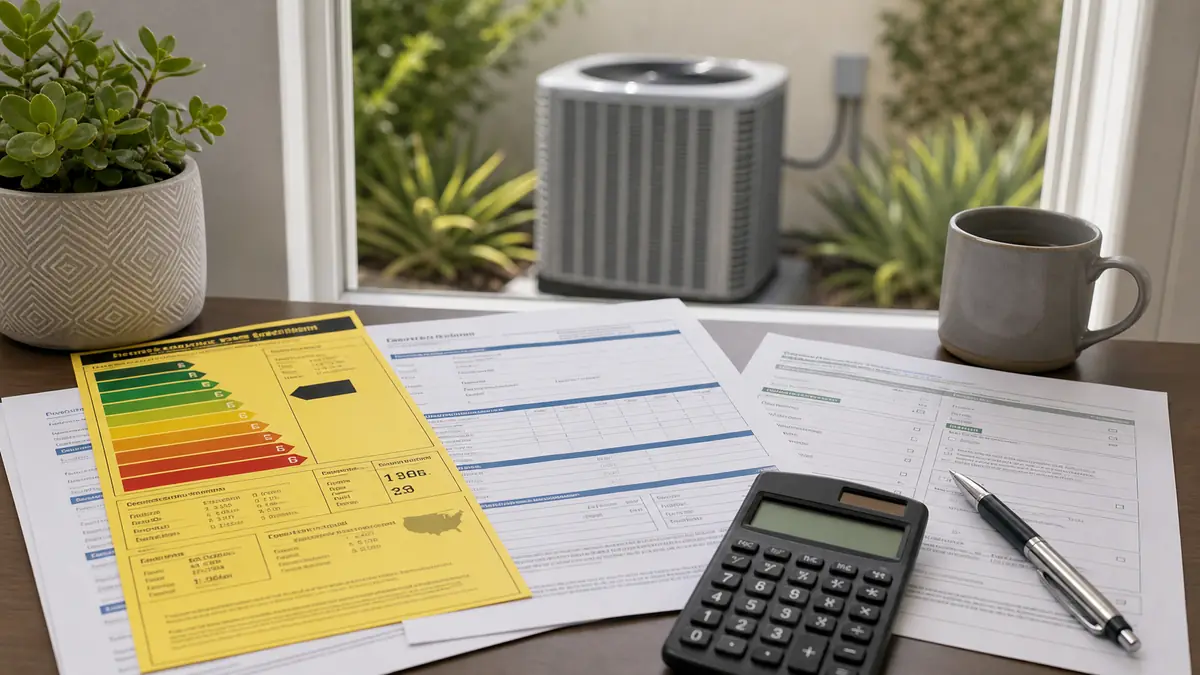
What does SEER2 mean and what is the Glendale minimum?
SEER2 is the cooling-efficiency scorecard that replaced the older plain-SEER rating on January 1, 2023, when the DOE switched to a test that runs the equipment against higher external static pressure - conditions that track much closer to how a system actually performs once it is tied into real ductwork. A higher SEER2 number means more cooling delivered for each unit of electricity burned. California falls inside the DOE Southwest region, so the floors we answer to are the tightest in the nation, drawn up on purpose to clear out the weakest equipment in the hottest cooling territory.
The table lays out the minimum your new Glendale gear is required to top. Treat these as the federal floors only; a lot of homeowners around here install something comfortably above them, and Mitsubishi's premium ductless families (MSZ-FS, MSZ-FX) reach far higher SEER2 in the small single-zone sizes. Since these standards get rewritten over time, confirm the current figure for your exact equipment class before you sign anything.
| Equipment | Minimum rating | Notes |
|---|---|---|
| Split AC, under 45,000 BTU | 14.3 SEER2 / 11.7 EER2 | Southwest region (CA) |
| Split AC, 45,000 BTU and up | 13.8 SEER2 / 11.2 EER2 | Larger systems |
| Split-system heat pump | 14.3 SEER2 and 7.5 HSPF2 | National minimum (~15 SEER / 8.8 HSPF old) |
Which HVAC rebates still exist for Glendale in 2026?
This is the part where I owe you the plain truth, because the rebate landscape changed sharply heading into 2026 and plenty of out-of-date advice is still circulating. The single largest federal lever no longer exists - the Section 25C tax credit was repealed as of December 31, 2025. State and utility offers remain on the books, though a handful were reported on hold or booked out as the year opened. Below is the portion that genuinely lands for Glendale homeowners, and you should match every dollar amount against the official page before banking on it.
| Program / authority | Reported for heat-pump / efficiency upgrades | Status caveat |
|---|---|---|
| Federal 25C tax credit (IRS) | 30% up to $2,000 for heat pumps | EXPIRED 12/31/2025 - none for 2026 installs |
| LADWP heat-pump rebate | Up to ~$2,500 per ton, tiered by efficiency | Verify per-ton amount, tiers, and date |
| SCE building electrification | ~$1,000 per HVAC system, up to two per home | SCE electric customers; verify |
| SoCalGas HEER | Up to ~$600 furnace; up to ~$50 smart thermostat | Gas customers; annual schedule; verify |
| TECH Clean California | ~$1,000-$1,500 market-rate; HEEHRA higher | Single-family funds reported reserved/waitlist |
Here is one pointer that saves Glendale homeowners some wasted effort: cross BayREN Home+ and 3C-REN off the list entirely. BayREN operates throughout the nine Bay Area counties, and 3C-REN covers Ventura, Santa Barbara, and San Luis Obispo - none of which include Los Angeles County, which means neither program reaches a Glendale address. Put your energy into LADWP, SCE, SoCalGas, and TECH instead.
How do LADWP and the utilities differ for a Glendale home?
The right program hinges on who supplies your electricity and your gas. With LADWP as your electric utility, the move is the per-ton heat-pump rebate; because it is tiered, a higher-efficiency Mitsubishi unit landing in a top tier (think entry near 15.2 SEER2 / 7.7 HSPF2 and reaching up toward 20.5 SEER2 / 9.1 HSPF2) earns more per ton - and a 4-ton top-tier system could approach $10,000 if the reported numbers stick. SCE electric customers and SoCalGas customers each travel their own path. Funding here drains and refills in cycles, so the wise approach is to verify the status the same week you plan to buy rather than months ahead.
What does Title-24 add on top of efficiency minimums?
Meeting SEER2 gets you only part of the distance. California's Title-24, Part 6 energy code governs how the equipment is actually installed here in Climate Zone 9, where Glendale sits. Take out a split system and you will normally owe refrigerant-charge and airflow verification, while reworking the ducts usually layers on duct sealing backed by independent HERS field verification. That code has been leaning hard into heat-pump-ready and heat-pump-preferred baselines, which lines up neatly with a Mitsubishi inverter or Hyper-Heat install. Before you sign off, pin down the precise triggers and whether the 2022 or the 2025 code cycle applies to your project.
How should a Glendale homeowner weigh SEER2 against cost?
Higher efficiency pays back quickest where the system logs the most hours, and Glendale's long cooling season is precisely that setting. Even so, the premium on a top-tier unit only earns out when the equipment is sized correctly and installed to spec - drop an oversized high-SEER2 system in and it short-cycles, squandering the very rating you paid extra for. For most homes here, a properly sized mid-to-high tier Mitsubishi inverter, tuned with verified charge and airflow, wins over chasing the largest nameplate number. Our sizing guide lays out how that calculation is actually performed.
Worked example: does a higher-SEER2 Mitsubishi pay back in Glendale?
Put rough numbers on it. Say a 3-ton system runs around 1,200 cooling hours across a Glendale summer (a long season for the LA basin). Step from a 14.3 SEER2 baseline AC to a roughly 24 SEER2 Mitsubishi inverter and you cut electricity per unit of cooling by close to 40 percent. At a SoCal residential rate near $0.30 per kWh, the annual cooling-energy savings on that move commonly land in the $250-$450 range, depending on how hard you actually run it.
| Scenario | Approx. annual cooling cost | Notes |
|---|---|---|
| 14.3 SEER2 baseline AC | ~$750-$950 | Federal Southwest minimum |
| ~24 SEER2 Mitsubishi inverter | ~$450-$600 | MSZ-FS / MSZ-FX class |
| Annual difference | ~$250-$450 saved | Long Glendale season favors efficiency |
If the high-efficiency Mitsubishi costs $2,000-$3,000 more installed than the baseline, simple payback often runs 6-10 years before any rebate, and a LADWP per-ton rebate can shorten that meaningfully. The catch repeats: that math only holds if the unit is right-sized. An oversized high-SEER2 system short-cycles and never delivers the rated savings, so spend on correct sizing before you spend on a higher nameplate number.
Worked example: stacking rebates on a Glendale heat-pump conversion
Electrification is where the remaining money concentrates. Say a Glendale homeowner swaps a gas furnace and aging AC for a 4-ton Mitsubishi Hyper-Heat ducted heat pump (an SVZ/MVZ air handler on an MXZ-SM or PUZ outdoor unit), a job that might run $12,000-$16,000 installed in this market. The federal 25C credit is gone for 2026, so the stack is now state and utility only.
| Program | Reported potential | Catch |
|---|---|---|
| LADWP per-ton heat-pump rebate | Up to ~$2,500/ton, tiered - a 4-ton top tier could approach ~$10,000 | LADWP electric customers; verify tier and date |
| TECH Clean California | ~$1,000-$1,500 market-rate | Single-family funds reported reserved/waitlist early 2026 |
| SoCalGas (if any gas equipment remains) | Limited; mostly furnace/thermostat | Going all-electric usually forfeits gas rebates |
The honest read: LADWP customers have by far the strongest lever here because the per-ton rebate scales with capacity and efficiency tier, while SCE customers fall back to the ~$1,000-per-system path. Confirm your electric provider first (LADWP vs. SCE serve different parts of the Glendale area), then verify each program's funding status the same week you commit, because these pots drain and refill in phases.
How does SEER2 compare to the old SEER ratings?
If you are cross-shopping an older unit's label, the ratings do not line up one-to-one. SEER2 tests against higher external static pressure - closer to real ducted conditions - so a SEER2 number runs a little below the legacy SEER figure for the same equipment. As a rough field guide, 14.3 SEER2 is roughly equivalent to about 15 SEER in the old system, and 7.5 HSPF2 maps to roughly 8.8 HSPF. The practical takeaway for Glendale: do not assume a high old-SEER unit pulled from a listing meets today's Zone 9 minimum, and confirm the SEER2/HSPF2 figure on the current AHRI certificate for the exact indoor-outdoor match before you buy.
Common questions
What is the minimum SEER2 for a new AC in Glendale?
Glendale lives inside the DOE Southwest region, which sets the country's stiffest cooling bar, so the floor your new split central AC has to clear is 14.3 SEER2 / 11.7 EER2 on anything below 45,000 BTU, dropping to 13.8 SEER2 / 11.2 EER2 at 45,000 BTU and larger. Going with a split heat pump instead puts you on a separate minimum: 14.3 SEER2 alongside 7.5 HSPF2. Have whoever quotes you confirm the live figure for your precise equipment class first, since these get revised.
Is the federal heat-pump tax credit still available in 2026?
No, that door has closed. Lawmakers wound down the federal Section 25C Energy Efficient Home Improvement Credit on December 31, 2025, which means the only equipment that still counts is whatever you purchased and had installed on or before that day, claimed on the 2025 return you file in 2026. Put a heat pump into a Glendale home anytime in 2026 and there is no 25C money behind it, so keep it out of your budgeting and lean on current IRS guidance to confirm.
Which rebates can a Glendale homeowner actually use right now?
For a Glendale address the live options come down to LADWP, SCE, SoCalGas, and TECH Clean California; the Bay Area and tri-county programs never extend as far as LA County. Going into 2026 a few heat-pump offers were reported on pause or booked out, so the honest play is to open each agency's own page and verify both the funding status and the actual dollar amounts before you count on any of it.
Does a higher SEER2 system pay off in Glendale?
Often it does, since our cooling season is long and the unit logs a lot of hours, which lets the efficiency savings stack up over time. The catch is that the actual return hinges on how much you run it, what you pay per kilowatt-hour, and how much extra the higher tier costs up front. A properly sized mid-tier inverter will usually outperform a bloated top-tier unit, because the rating only earns its keep when the system is sized and installed the right way.
What does Title-24 require for a Glendale system change?
Because Glendale sits in Climate Zone 9, changing out a split system usually carries refrigerant-charge and airflow verification, and once you open up the ducts you typically add duct sealing that an independent rater signs off via HERS field verification. The last few code cycles have tilted steadily toward heat-pump-ready and heat-pump-preferred baselines. Settle which of these triggers apply to your exact address, and which code cycle governs the work, before anyone picks up a tool.
Related: HVAC sizing and Manual J, Hyper-Heat heat pumps for electrification, and smart thermostat installation for control rebates.