Frozen Evaporator Coil on a Glendale Mitsubishi System
Bottom line first: A frozen coil on a Glendale Mitsubishi system almost always means restricted airflow or low refrigerant rather than the weather, so Glendale Mitsubishi HVAC, serving Adams Hill and the Verdugo foothills (ZIP 91206), tells you to turn the unit off to thaw, then call (213) 755-3565 or book online for a diagnosis before the ice slugs and damages the compressor. P6 is the usual freeze code.
Good to know
- Top causes: dirty filter/coil (airflow), low refrigerant (leak), stuck LEV/EEV, failed blower.
- Mitsubishi often flags this as P6 freeze/overheat protection before solid ice forms.
- First step: turn the system off and let it thaw one to three hours before restarting.
- Airflow/cleaning fix $200-$600; refrigerant leak + recharge $225-$1,500.
- Service area: Glendale plus Adams Hill, Rossmoyne, Verdugo Woodlands, El Miradero (91201-91208).
- Repeated freezing risks compressor slugging - treat it as urgent.
- Independent; in-warranty units referred to authorized service first.
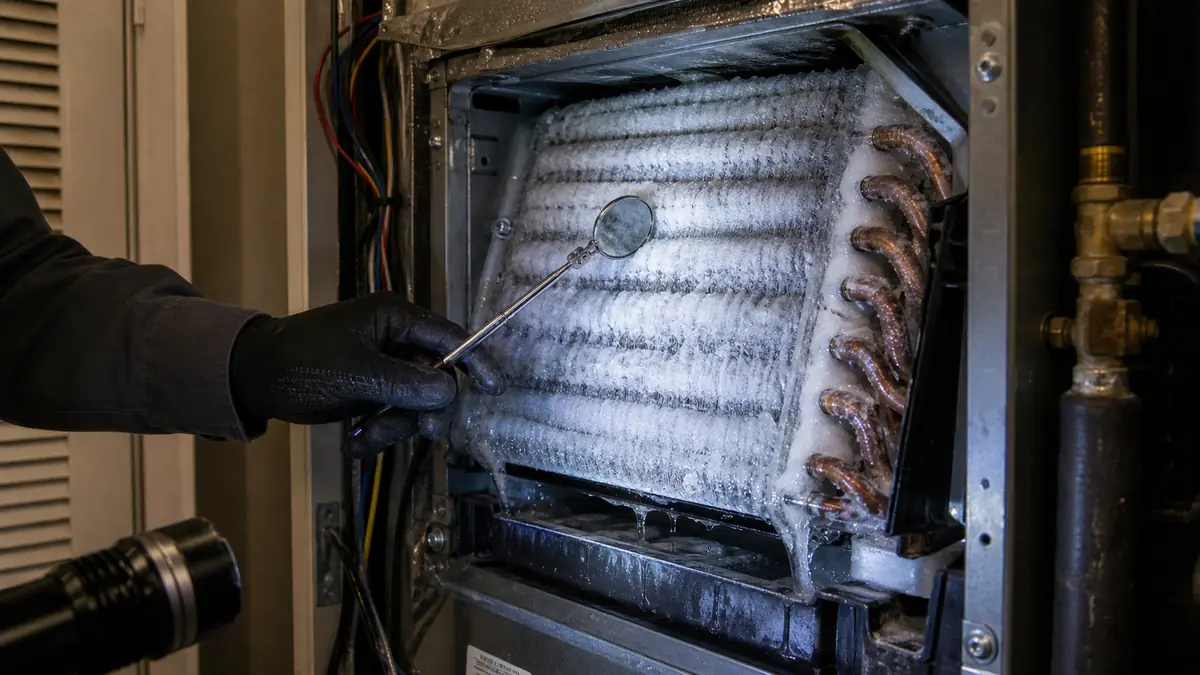
What makes a Mitsubishi coil freeze in Glendale?
Two families of cause produce nearly every frozen coil we see in Glendale: not enough air over the coil, or not enough refrigerant in it. Glendale's spring pollen and dust off the Verdugos clog ductless filters fast, and a flare-joint leak on an older line set slowly drops the charge. Either one cools the coil below 32 F and condensation turns to ice. The table sorts the cause, the tell, and the 2026 cost lane.
| Symptom / code | Likely cause / first check | Cost lane |
|---|---|---|
| Ice on indoor coil, dirty filter, P6 | Restricted airflow - clean filter and coil | $200-$600 |
| Frost on line set, weak cooling, P8/U7 | Low refrigerant from a flare-joint leak | $225-$1,500 |
| Freezing with clean filter, uneven cooling | Sticking LEV/EEV expansion valve | $300-$900 |
| Weak airflow then ice, blower slow | Failed/dirty ECM blower or wheel (ducted) | $450-$2,300 |
What should I do the moment I see ice?
Switch the system off or to fan-only so the blower keeps moving air and melts the ice faster, and give it one to three hours to thaw completely before any restart. Replace or wash the filter while you wait - on a ductless head the filters lift right out. Do not chip at the ice, and do not add refrigerant; if the cause is a leak, topping it off just delays the real fix and wastes refrigerant.
How does a tech diagnose a frozen Mitsubishi coil, step by step?
A frozen coil hides its real cause under ice, so the diagnosis follows a set order once the unit has thawed. We start at the controller or the kumo cloud app and read any stored code - a P6 freeze/overheat trip points at airflow, a P8 abnormal pipe temperature or a U7 low discharge superheat points at refrigerant. Then we work the physical checks: pull and inspect the filter and indoor coil for the airflow path, measure the temperature split across the coil (a healthy split runs roughly 16-22 F; a narrow split with ice signals low airflow or low charge), and check the blower wheel and ECM motor for fouling or slow spin.
If airflow checks out clean, we move to the refrigerant circuit: gauge the charge, read superheat and subcooling, and inspect the flare joints at the head and condenser where ductless leaks usually start. A sticking LEV/EEV electronic expansion valve shows up as uneven coil temperatures with a clean filter and correct charge. Only after the readings name the fault do we quote, because ice itself is a symptom, not a diagnosis.
What can you safely check yourself, and when do you call?
Two things are safe DIY on a frozen coil: switch the system to off or fan-only and let it thaw fully (one to three hours), and clean or replace the filter - on a ductless head the filters lift right out. Both are airflow fixes you can do without tools. Stop there. Do not add refrigerant, do not chip ice off the coil, and do not keep running a unit that re-freezes. If the coil ices again after a clean filter and a full thaw, if the line set frosts with weak cooling, or if you see a P8/U7 code, call - those point at a leak or a valve fault that needs gauges and certification to fix safely.
Why is the Verdugo climate hard on coils?
Glendale's long cooling season - 35 to 50 days a year over 90 F, with canyon pockets holding heat into the evening - means coils run for hours at a stretch. A marginal charge or a half-blocked filter that would survive a short cycle instead runs long enough to ice over. Foothill homes in Verdugo Woodlands and El Miradero, where windows stay closed against afternoon heat and filters load with hillside dust, freeze most often.
Common questions
Should I turn my Glendale AC off if the coil is frozen?
Yes. Switch the system to off (or fan-only) and let the ice melt fully, which can take one to three hours. Running a frozen system keeps starving the coil of airflow and can push liquid refrigerant back to the compressor, turning a cheap airflow fix into an expensive one. Once thawed, swap the filter and call for a diagnosis.
Why does my mini-split freeze when it is 90 F outside in Glendale?
Freezing in heat is almost always airflow or refrigerant, not weather. A clogged filter or dirty indoor coil starves airflow so the coil drops below freezing; a low charge from a flare-joint leak does the same by dropping coil pressure. Mitsubishi often flags this as a P6 freeze/overheat protection trip before it ices solid.
What does it cost to fix a frozen coil in Glendale?
If it is just a dirty filter or coil, a cleaning and airflow correction sits in the $200-$600 range. If the cause is a refrigerant leak, repair and recharge runs $225-$1,500 depending on the leak. A stuck LEV/EEV or thermistor adds parts cost. We confirm the cause before quoting.
Can a frozen coil damage my Mitsubishi compressor?
It can. Ice blocking the coil reduces heat absorption, and continued running can flood the compressor with liquid refrigerant (slugging), which wears or damages it over time. That is why we treat repeated freezing as urgent - the cheap fix today prevents a $1,200-$3,500 inverter compressor later.
Related: weak airflow from vents often precedes a freeze; see AC repair and maintenance plans that prevent it.