Mitsubishi AC Installation in Glendale, CA
Bottom line first: Glendale Mitsubishi HVAC installs Mitsubishi ductless and inverter AC across Glendale, from Adams Hill to El Miradero (ZIP 91205), sizing every system with a Manual J load instead of a square-foot rule so it cools without short-cycling, so call (213) 755-3565 or book online for a written quote. Single-zone installs run $3,500 to $8,000.
Good to know
- Every system sized by Manual J load, not a square-foot rule of thumb.
- Service area: Glendale plus Adams Hill, Rossmoyne, Verdugo Woodlands, Glenoaks Canyon, El Miradero (91201-91208).
- Indoor units: MSZ wall heads, MFZ floor consoles, MLZ ceiling cassettes, SVZ/MVZ ducted air handlers.
- Outdoor units: MUZ single-zone, MXZ/MXZ-SM multi-zone, plus Hyper-Heat NAH/NLHZ for cold canyon lots.
- Single-zone $3,500-$8,000; multi-zone (3-4 heads) $9,000-$20,000; ducted inverter $6,000-$14,000.
- Hours: Weekdays 6am-8pm, emergency service on call.
- Independent; we install new systems and pick up out-of-warranty service the next shop will not.
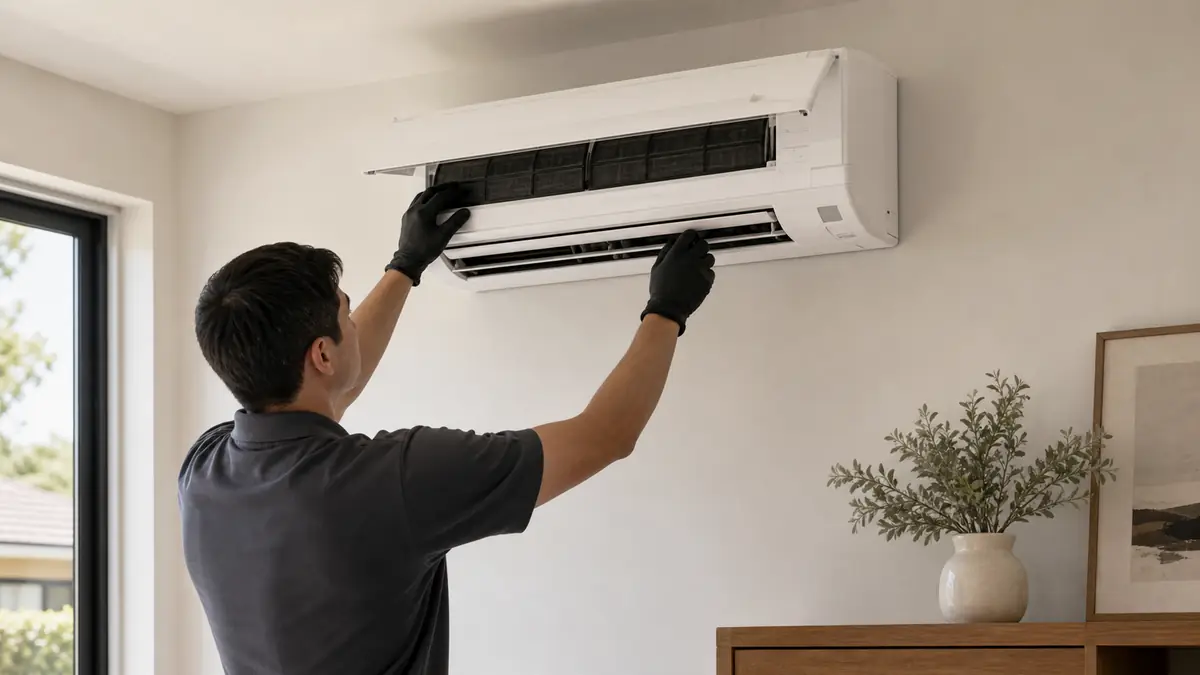
Why is ductless the default AC install in Glendale?
Most of Glendale's pre-1940 flatland - the Spanish Colonial revival, Tudor cottages, and Craftsman bungalows around Brand Park and Adams Hill - was framed with plaster-and-lath walls and no duct chase. Cutting central ductwork into that stock means losing closet depth and ceiling height, and the soffit work alone can outrun the cost of cooling. A Mitsubishi wall head solves it with a roughly three-inch line-set penetration through an exterior wall and a small condensate route, so the original interior stays intact.
The terrain reinforces the choice. Glendale climbs from a flat Downtown grid into the Verdugo foothills, and the hillside and canyon homes in Glenoaks Canyon, El Miradero, and Verdugo Woodlands sit in heat pockets that hold load into the evening. A right-sized inverter condenser modulates against that long afternoon load instead of slamming on and off the way an oversized single-stage central unit would. That is why a Glendale cooling install usually lands on an M-Series ductless system rather than a furnace-and-duct rebuild.
Which Mitsubishi indoor unit fits each room?
The install changes with the indoor unit, so we match the head to the room before pricing the job. Picking the right unit matters more than chasing the highest SEER2 number a brochure lists.
- MSZ-FS wall head (3D i-see sensor). The occupancy and heat-detection sensor steers airflow toward where people sit, so it goes in main living rooms and primary bedrooms; paired to a MUZ-FS it reaches roughly 30.5 SEER2 single-zone.
- MSZ-WR / MSZ-GL wall heads. The value workhorses (MSZ-WR near 18 SEER2) for a back bedroom or attic conversion where budget leads the decision.
- MSZ-FX wall head (H2i plus). The newest high-efficiency line, up to roughly 35 SEER2 in small sizes, matched to a MUZ-FX NLHZ for a small, cold canyon room.
- MFZ-KJ floor console. Sits at baseboard height and throws air upward, a clean swap where a window or low ceiling line blocks a high wall mount, or where you are replacing old electric baseboard heat.
- MLZ-KP one-way ceiling cassette. The EZ FIT recessed unit fits between joists and disappears into a finished ceiling when you do not want a visible head.
- SVZ / MVZ ducted air handler. A multi-position concealed unit for a home that already has usable ducts and wants one hidden whole-home system on a single thermostat.
How does a Mitsubishi AC install actually go, step by step?
A clean install is mostly planning, and the order we follow keeps the equipment right-sized and the exterior intact. The job runs in five stages.
- Manual J load. We measure each room - wall insulation, window area and orientation, ceiling height, infiltration - and compute the real cooling and heating load. A south-facing room behind single-pane glass in a Rossmoyne ranch pulls far more than a shaded north room, and that number sets the head capacity, not the floor area.
- Equipment selection. We match each room to a head (MSZ-FS, MSZ-FX, MFZ-KJ, or MLZ-KP) and pick the smallest MUZ or MXZ-SM condenser that covers the combined load, so the inverter modulates through the afternoon instead of short-cycling.
- Line-set and condenser routing. We map the slim bundle - liquid and suction lines, condensate drain, and the S1/S2/S3 control cable, together about the diameter of a garden hose - and place the MUZ where it is quiet, serviceable, off the primary street elevation, and on a level pad that a stepped hillside lot does not always offer.
- Mount, flare, pressure-test, and evacuate. Heads go on backplates anchored to framing, flares are made and torqued to spec, then the circuit is pressure-tested with nitrogen and pulled into a deep vacuum (down toward 500 microns) to remove moisture before any refrigerant goes in.
- Charge and commission. We weigh in refrigerant to the nameplate charge, verify superheat and subcooling under load, set up the kumo cloud adapter or MHK2 control, and confirm the refrigerant-charge and airflow verification Title-24 asks for in Climate Zone 9 before we hand it over.
What does an AC install cost in Glendale, and why?
A single-zone Mitsubishi cooling install runs $3,500 to $8,000, a three- to four-zone MXZ-SM system $9,000 to $20,000 at the SoCal range, and a ducted SVZ/MVZ inverter system $6,000 to $14,000. The spread is driven by zone count, line-set length, head tier, and electrical scope rather than square footage alone. The table maps the common Glendale projects to typical 2026 lanes.
| Project | Typical equipment | Cost lane |
|---|---|---|
| One room, addition, or attic conversion | Single MSZ head + MUZ condenser | $3,500-$8,000 |
| Whole ductless bungalow, no ducts | MXZ-SM driving 3-4 MSZ heads | $9,000-$20,000 |
| Larger foothill home, many rooms | MXZ-SM driving 5-6 zones | $14,000-$20,000+ |
| Home with usable ducts | SVZ/MVZ ducted inverter air handler | $6,000-$14,000 |
| All-electric conversion, drop the furnace | Hyper-Heat MUZ-FS NAH or MXZ-SM MHZ | $6,000-$16,000 |
| New or replaced ductwork for a ducted job | Sealed duct runs, HERS-verified | $1,900-$6,000 add-on |
What drives the price in Glendale
Two homes with the same floor area can quote thousands apart. The cost drivers we see most here:
- Zone count and head tier. Each added zone is another head, another line set, and more refrigerant; an MSZ-FS with the i-see sensor costs more than a basic MSZ-GL.
- Line-set length and hillside access. A head far from the only level condenser pad on a stepped Glenoaks Canyon or El Miradero lot needs a long line set and staged labor, and a color-matched line-set cover to keep a historic facade clean adds material.
- Electrical. A dedicated circuit, and on older Adams Hill and Downtown homes some panel-capacity work, since plenty of pre-1940 services are undersized for a modern condenser.
- Hyper-Heat upgrade. A MUZ-FS NAH or MUZ-FX NLHZ cold-climate condenser carries a premium over a standard unit, worth it on an all-electric conversion or a cold canyon morning.
- Permits and HERS verification. Title-24 in Zone 9 typically requires refrigerant-charge and airflow verification, and duct alterations trigger HERS field testing on the ducted path.
Single-zone, multi-zone, or ducted - which should you install?
The right architecture depends on how much of the house needs cooling and whether ducts already exist. A single MSZ head on its own MUZ condenser is the simplest and cheapest path for one open room or an addition. A multi-zone MXZ-SM SMART MULTI runs three to eight indoor units - any mix of M-Series, P-Series, and CITY MULTI heads - off one outdoor unit, which suits a whole ductless floor plan without a row of condensers cluttering a side yard. A ducted SVZ or MVZ inverter air handler wins when the home already has usable ducts and you want one thermostat over the whole house. We pick the platform off the Manual J and the home's existing infrastructure rather than defaulting every job to wall heads.
How does Glendale's housing and terrain shape the install?
The flatland and the foothills install differently. On a flat Downtown or Rossmoyne lot the condenser sits on a simple ground pad with a short line set, and the constraint is usually panel capacity in an older home. Climb into Verdugo Woodlands, Glenoaks Canyon, or El Miradero and the lot is stepped, the only level pad may be a story below the head it serves, and the heat pocket holds load late - so we size the condenser for that sustained afternoon runtime and route the line set to keep it short and serviceable. On the pre-1940 Spanish, Tudor, and Craftsman stock near Brand Library, we plan condenser placement and a color-matched line-set cover to keep the street facade clean, the same care a historic block deserves.
What about rebates and Title-24 on a new install?
Any system you put in around Glendale answers to California's Title-24, Part 6 energy code and the SEER2 efficiency floor, and in Climate Zone 9 a split-system change normally carries refrigerant-charge and airflow verification, with HERS field testing once you alter ducts. A heat-pump setup may line up with LADWP, SCE, SoCalGas, or TECH Clean California incentives, though those move in funding rounds and several were reported reserved or paused by early 2026; the federal 25C tax credit was repealed effective 12/31/2025, so nothing federal applies to a 2026 install. We run the application with you but confirm a program is live before committing a number to paper - the full picture is on our SEER2 and rebates guide.
How do we size the system so it actually cools?
Sizing is where most cooling installs go wrong, and an oversized Mitsubishi system is its own failure mode. A condenser too large for the load satisfies the thermostat in short bursts, never runs long enough to pull humidity, and cycles the inverter so often that efficiency and comfort both suffer. We run a real Manual J - factoring Glendale's Zone 9 design temperature, the home's insulation and glazing, infiltration, and orientation - then choose the smallest condenser that covers the calculated load with a little headroom, not a unit picked off a square-foot chart. On a multi-zone MXZ-SM we also check that the combined head capacity stays within the outdoor unit's rated range, because over-heading a multi-zone is the quiet way to starve every room at once. If a replacement is on the table, our sizing and Manual J guide walks the math.
Common questions
Can you add AC to a Glendale Spanish home that has no ducts?
Yes, and ductless is almost always the right call. We mount Mitsubishi MSZ wall heads or MFZ floor consoles room by room and run a slim line set down an exterior wall, so there is no central duct to thread through 1920s plaster-and-lath framing near Brand Park. A single MSZ/MUZ zone installs in about a day; book online or call for a Manual J load.
How many zones does a typical Glendale house need?
It tracks the Manual J load and how you use the rooms, not raw square footage. A 1,300 sq ft Adams Hill bungalow often cools well on a two- or three-head MXZ-SM, while a larger Rossmoyne or Verdugo Woodlands home may want four to six heads. We measure room by room, because an oversized condenser short-cycles and wastes the inverter's modulation.
What does a Mitsubishi AC install cost in Glendale in 2026?
A single-zone MSZ head with a matched MUZ condenser runs about $3,500 to $8,000 installed, depending on capacity and line-set length. A three- to four-zone MXZ-SM system lands around $9,000 to $20,000 at the SoCal high end, and a ducted SVZ/MVZ inverter system runs $6,000 to $14,000. We quote in writing after the load calculation.
Why does a hillside Glenoaks Canyon lot cost more to install?
Two reasons: line-set length and condenser access. A head on the upper floor of a stepped El Miradero or Glenoaks Canyon home sits far from the only flat pad for the MUZ, so the refrigerant line set runs long and labor climbs. Tight side-yard setbacks and stairs also slow the set, which is why a canyon single-zone leans toward the top of its $3,500 to $8,000 lane.
Should I get a Hyper-Heat condenser for a Glendale install?
Usually only if you are dropping the gas furnace or face cold canyon mornings. Glendale's flatland winters rarely dip far, so a standard MUZ-FS heats fine there. For a cold Glenoaks Canyon pocket that drops into the 30s, or an all-electric conversion, a Hyper-Heat MUZ-FS NAH or MUZ-FX NLHZ holds capacity near -5 F and is worth the premium.
Are there rebates for a heat-pump AC install in Glendale?
Maybe, but verify before you bank on it. Heat-pump incentives have run through LADWP, SCE, SoCalGas, and TECH Clean California, and several were reported reserved or paused by early 2026; the federal 25C credit was repealed effective 12/31/2025, so nothing federal applies to a 2026 install. We run the paperwork with you and confirm a program is still funded before naming a dollar figure.
Will a new mini-split be loud or look bad on my historic facade?
No on both counts. An MSZ indoor head runs near the low 20s of decibels on low fan, and the outdoor MUZ is one compact unit, not a row of condensers. We place the condenser off the primary street elevation and color-match a line-set cover to the wall, so a 1920s Tudor or Craftsman facade near Brand Library stays clean. That placement planning is part of every quote.
Related: wall-mount mini-splits, multi-zone systems for whole-home coverage, Hyper-Heat heat pumps, and AC repair if you have an existing system.