Emergency AC Repair in Glendale, CA
Bottom line first: Glendale Mitsubishi HVAC takes on-call emergency AC repairs across Glendale, including Glenoaks Canyon and El Miradero (ZIP 91207), for Mitsubishi Electric no-cool failures during heat spells, diagnosing the fault code fast, restoring cooling same-visit where we can, and quoting the trip rate before we roll, so call (213) 755-3565 now or book online. Vulnerable households are prioritized.
Reach a technician at (213) 755-3565. Weekday hours are 6am-8pm with emergency on call for heat-event failures.
Good to know
- On-call emergency response for Mitsubishi no-cool failures during heat events.
- Service area: Glendale plus Glenoaks Canyon, El Miradero, Verdugo Woodlands, Adams Hill (91201-91208).
- Climate Zone 9: 35-50 days a year over 90 F; canyon pockets hold heat past sunset.
- Same-visit fixes for capacitors, contactors, drains, and wiring faults.
- Inverter boards and compressors are ordered; we stabilize airflow first.
- Emergency trip rate quoted before dispatch - never after.
- Independent; in-warranty units referred to Mitsubishi-authorized service first.
- Typical pricing range: $109 - $17,000.
What should I check before calling for emergency service?
Two safe checks can save a trip. Confirm the breaker for the condenser and air handler has not tripped, and reset it once - if it trips again, stop and call, because a repeat trip points at a shorted compressor or board, not a fluke. Then check that the thermostat or MHK2 controller is calling for cool and the indoor filter is not fully blocked. Do not pour water into a unit, pull panels, or top off refrigerant yourself.
| What you see | Likely cause / first check | Cost lane |
|---|---|---|
| Outdoor unit silent, fan dead, hum only | Run capacitor or contactor failed | $150-$450 |
| Breaker trips immediately on reset | Shorted compressor, board, or wiring - stop, call | Diagnostic $79-$200, then board/compressor |
| Water flooding from indoor head, unit off | Drain/pump clog, float open (P4/P5) | $150-$450 |
| Runs but blows warm, frost on line set | Low refrigerant from a leak, EEV fault (U7) | $225-$1,500 |
| Shuts off in afternoon heat, U2 high discharge | Overheating compressor, low charge, blocked coil | $225-$3,500 by root cause |
| Trips on U6 overcurrent during long runtime | Inverter PCB/IPM or compressor overcurrent | Board $400-$2,000; compressor $1,200-$3,500 |
| Burning smell or scorched terminal | Failed contactor, wiring, or board - power off, call | Diagnostic first; then part lane |
How does an emergency no-cool call run, start to finish?
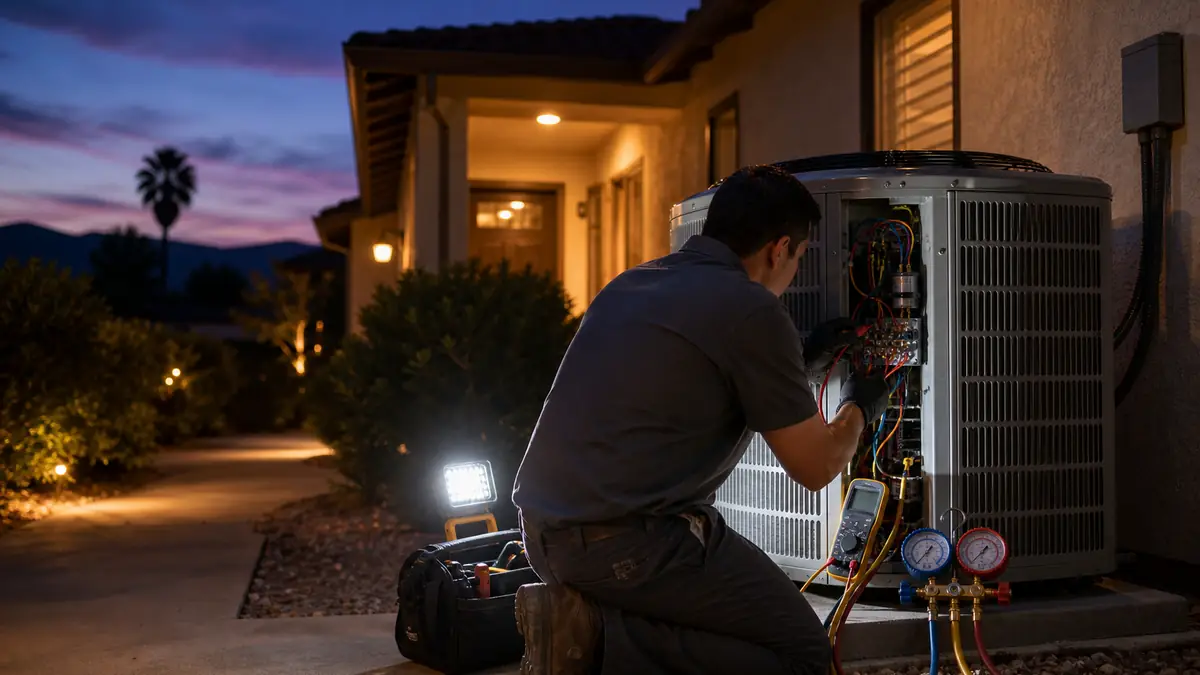
An emergency visit is the standard diagnostic sequence compressed for speed and stabilized for safety. The goal is to get cooling back the same visit where the failed part is on the truck, and to make the home safe and set a firm return where it is not.
- Triage by phone. We ask what the unit is doing and whether anyone in the home is vulnerable, so the dispatch order and the parts on the truck match the likely fault before we arrive.
- Make it safe. On arrival, if a breaker is repeat-tripping or a terminal is scorched, we kill power first and rule out a shorted compressor or board before anything else.
- Read the code fast. We pull the P, U, or E code from the indoor LED, kumo cloud, or MHK2 - a P5 drain trip and a U6 overcurrent send the repair in completely different directions.
- Fix or stabilize. Capacitor, contactor, drain clog, dirty filter, or a loose S2/S3 connection - those finish on the spot. An inverter board or compressor is ordered against the model number; meanwhile we restore what airflow we safely can.
- Verify and quote the return. Where we repair, we confirm the code cleared and the unit holds under load. Where we order, you get the part cost, lead time, and a firm return slot before we leave.
Which faults are same-visit versus an ordered part?
Knowing this up front sets your expectations during a heat panic. Same-visit fixes are the electrical and airflow faults that ride on the truck; ordered parts are the model-specific electronics.
- Usually same visit: dual-run capacitor, welded contactor, clogged condensate drain or stuck float (P4/P5), dirty filter starving the coil (P6), and a loose or corroded S1/S2/S3 inter-unit connection reading as an E6 or E7 comm fault.
- Usually ordered: the inverter PCB or IPM behind a U5 or U6 fault, the DC inverter compressor behind a confirmed U2/U6, and the outdoor DC fan motor behind a U8 - each ordered against your exact MSZ, MUZ, MXZ, or P-Series model.
- Either, depends on cause: a U7 low-refrigerant trip is same-visit if it is a simple flare remake and recharge, or a return if the leak is in a coil or buried line set.
Which Glendale homes lose cooling first in a heat wave?
The hillside and canyon stock fails earliest. Mid-century ranches in Verdugo Woodlands and homes tucked into Glenoaks Canyon and El Miradero sit in pockets that radiate heat into the evening, so an undersized or aging condenser there runs hours longer than one on a flat Downtown Glendale block. Those long runs are what trip U2 high discharge temperature and U6 compressor overcurrent on a Mitsubishi outdoor unit.
What can you actually fix on an emergency call?
Most no-cool emergencies come down to electrical and airflow faults that travel on the truck: a failed dual-run capacitor, a welded contactor, a condensate clog tripping protection, a dirty filter starving the coil, or a loose inter-unit connection reading as an E-code. Those we usually resolve the same visit. A failed inverter compressor or control board has to be ordered, so on those we restore what airflow we can, document the U-code, and set a firm return. If your unit is still under Mitsubishi warranty we will say so and point you to authorized service first.
Common questions
What counts as an HVAC emergency in Glendale?
A dead system during a heat event, a breaker that keeps tripping, burning smells, water pouring from an indoor head, or a vulnerable household (infants, elderly, medical needs) with no cooling. During a Verdugo heat spell with 90 F-plus evenings in the canyons, a no-cool call gets prioritized over routine maintenance.
Can you fix a no-cool Mitsubishi unit the same visit?
Often, yes. The most common no-cool causes - a failed capacitor, pitted contactor, clogged drain throwing a P5 protection trip, or a loose S2/S3 connection - are diagnosed and repaired on the truck. An inverter board or compressor must be ordered, but we can usually get airflow and a plan in place immediately.
Why did my Glenoaks Canyon AC quit at night, not midday?
Canyon pockets in the Verdugos trap heat and stay hot well past sunset, so a marginal condenser keeps running into the evening and trips on U2 high discharge temp or U6 overcurrent when it finally gives. The unit did not fail because of the dark; it failed from hours of sustained high load.
Is there an extra charge for after-hours emergency service?
Emergency and after-hours visits can carry a higher trip rate than a scheduled weekday call - we quote that before we roll, never after. The diagnostic still names the failed part and a 2026 price lane so you are not signing a blank check during a heat panic.
My Mitsubishi unit shut off and shows U2 - is it dangerous to keep trying?
Stop cycling it. U2 is a high-discharge-temperature trip, the unit protecting its own compressor from overheating, common on a marginal condenser after hours of canyon-heat runtime. Repeatedly forcing it back on risks the compressor. Leave it off, get airflow moving another way if you can, and call so we can find whether it is low charge, a blocked condenser coil, or the compressor itself.
What can I do to stay cool in Glendale while I wait for the tech?
Close blinds on the sun-facing side, run ceiling or box fans to move air, and move to the coolest lower-level room since heat rises - useful in two-story Verdugo Woodlands homes. Hydrate and check on elderly or infant household members first. Do not run the failing unit in a tripping loop or pour water into it; both can turn a same-visit fix into a parts order.
Will you prioritize my call if someone in the home is medically vulnerable?
Yes. A no-cool failure with infants, elderly residents, or medical-equipment needs moves up the queue during a heat event, especially in canyon and foothill pockets that hold heat past sunset. Tell us the situation when you call so we route the visit accordingly and, where we cannot arrive instantly, talk you through staying safe in the meantime.
Related: standard AC repair in Glendale, AC making noise, and maintenance plans that prevent most heat-event failures.