HVAC Maintenance Plans in Glendale, CA
Bottom line first: Glendale Mitsubishi HVAC offers annual maintenance plans across Glendale, including Verdugo Woodlands and Montrose-adjacent streets (ZIP 91208), that flush drains, verify charge, clean coils, and read stored codes on M-Series and P-Series systems before the summer load arrives, keeping them off the no-cool list, so call (213) 755-3565 or book online to schedule a spring visit. Service before June beats the July rush.
Good to know
- Annual or semi-annual visits timed before the June-September cooling load.
- Service area: Glendale plus Verdugo Woodlands, Montrose-adjacent, Adams Hill, El Miradero (91201-91208).
- Covers drain flush, coil and filter cleaning, charge and superheat check, capacitor/contactor test.
- We read and clear stored M-Series fault codes during the visit.
- Plan visits typically $109-$300 depending on system count and type.
- Documented service helps protect Mitsubishi warranty coverage.
- Independent; in-warranty units coordinated with authorized service where required.
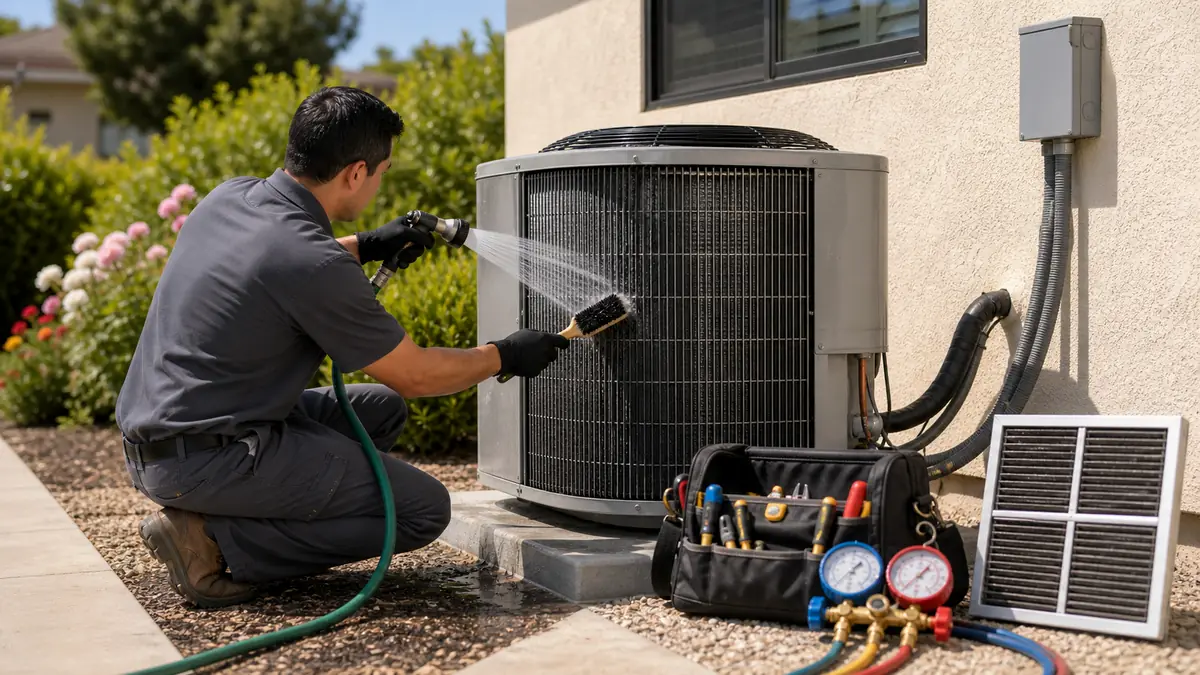
What does a Mitsubishi tune-up catch before summer?
Most heat-event breakdowns are not bad luck - they are deferred maintenance that finally fails under load. Glendale's spring brings Verdugo pollen and dust that pack ductless filters and coils, and a marginal capacitor that limped through last summer often will not survive another 90 F stretch. The table shows what a tune-up checks, the fault it heads off, and a rough 2026 cost if you wait until it breaks instead.
| Maintenance check | Failure it prevents / fault code | Reactive cost if skipped |
|---|---|---|
| Drain flush + pump test | Condensate backup, water damage (P4/P5) | $150-$450 |
| Coil and filter cleaning | Weak cooling, freeze trip (P6) | $200-$600 |
| Charge and superheat check | Low-refrigerant short-cycling (U7) | $225-$1,500 |
| Capacitor / contactor test | No-start on the hottest day | $150-$450 |
| Flare-joint and line-set inspection | Slow refrigerant leak, weak cooling (P8) | $225-$1,500 |
| S1/S2/S3 terminal and connection check | Comm-fault shutdowns (E6/E7) | $150-$2,000 by part |
What is on the annual checklist for a Mitsubishi system?
A real tune-up is a checklist, not a glance. On an M-Series ductless system the visit covers the indoor head, the line set, and the outdoor condenser in order, with every check tied to a failure it heads off.
- Filters and blower wheel. Wash or replace the mesh filters and clean the blower wheel, where Verdugo pollen and pet hair build up and choke airflow.
- Indoor coil and condensate path. Inspect and clean the indoor coil, flush the condensate drain, and bench-test the drain pump and float so a P4 or P5 trip does not flood a wall in August.
- Refrigerant charge and superheat. Verify charge against the nameplate and read superheat and subcool; a charge drifting low is the quiet cause of a midsummer U7 short-cycle.
- Flare joints and line set. Inspect the flare connections - the common ductless leak point - for weep or oil residue before they become a P8 leak code.
- Outdoor electrical. Meter the capacitor against rated microfarads, check the contactor contacts, and tighten the S1/S2/S3 inter-unit terminals so a marginal cap or loose wire does not pick the hottest day to fail.
- Stored codes. Read and clear any stored P, U, or E codes from the controller or kumo cloud so we catch a developing fault before it strands you.
When should each task happen on Glendale's calendar?
Glendale sits in cooling-dominant Title-24 Climate Zone 9, so the calendar is built around the June-September load, not a generic four-season cycle. Timing the work to the season is what keeps you off the July no-cool list.
- Late winter to early spring (February-March). Best window to clean coils, verify charge, and replace a marginal capacitor before any demand - shops are uncrowded and parts are easy to get.
- Spring (April-May). The core annual visit: full drain flush, filter service, and a top-to-bottom check so the system enters summer clean and correctly charged.
- Summer (June-September). Homeowner filter rinses roughly monthly under heavy use; this is peak load when canyon pockets hold heat past sunset and undersized or neglected units fail.
- Fall (October-November). A lighter check, and the time to confirm heat-pump heating and defrost work before the cooler canyon mornings, plus furnace igniter and limit checks on a gas pairing.
How does Glendale's climate set the maintenance calendar?
Glendale sits in cooling-dominant Title-24 Climate Zone 9, with 35-50 days a year over 90 F and canyon pockets that hold heat past sunset. That means the system carries its heaviest load June through September, so the right time to service is late spring - April or May - before the first heat spell. Waiting until July puts you in line behind every no-cool emergency in the Verdugo foothills.
What is different about maintaining ductless versus ducted?
On ductless M-Series, the work centers on the indoor head: the blower wheel, the indoor coil, and the condensate drain and pump that throw most nuisance shutdowns. On a ducted SVZ/MVZ air handler or a gas-furnace pairing, we add static-pressure readings, duct inspection, and on the furnace the igniter, flame sensor, and limit. Many Glendale homes run both, and a single annual visit can cover the mini-split and the furnace together.
Common questions
How often should a Mitsubishi mini-split be serviced in Glendale?
Once a year at minimum, ideally before the summer load arrives in June. Glendale dust, pollen off the Verdugos, and pet hair clog ductless filters and indoor coils faster than people expect, and a blocked coil is the most common cause of a P6 freeze-protection trip and weak cooling come July.
What does a maintenance visit actually include?
On an M-Series system we wash or replace filters, clear and flush the condensate drain and test the pump, check the indoor coil and blower wheel, verify refrigerant charge and superheat, inspect flare joints for weep, test the capacitor and contactor on the MUZ, and read any stored fault codes. On a ducted or furnace pairing we add static pressure and igniter checks.
Will maintenance really prevent a summer breakdown in Glendale?
It prevents the common ones. The failures we see most during heat events - clogged drains tripping protection, weak capacitors, and dirty coils starving airflow - are exactly what a spring tune-up catches. It will not predict a random inverter board failure, but it removes the avoidable causes that pick the hottest day to fail.
Is a maintenance plan worth it on a newer Mitsubishi install?
Yes, and not just for comfort. Mitsubishi parts-and-labor warranties generally expect the system to be reasonably maintained, so documented annual service helps protect coverage on a newer MSZ/MUZ. For a unit still under warranty, we coordinate with authorized service where the warranty requires it.
How do I clean a Mitsubishi mini-split filter between visits in Glendale?
Lift the indoor head's front panel, slide out the two mesh filters, and rinse them under lukewarm water or vacuum them, then let them dry fully before reseating - roughly monthly during heavy summer use. That handles dust and Verdugo pollen on the surface. It does not reach the indoor coil, blower wheel, or condensate pan, which is the deep cleaning the annual visit covers.
Does a multi-zone Mitsubishi system cost more to maintain in Glendale?
Somewhat, because each indoor head has its own filter, coil, drain, and LEV to check, and the branch box and S1/S2/S3 wiring add inspection points. A three-to-four-zone MXZ-SM visit takes longer than a single MSZ head, so it sits at the higher end of the $109-$300 plan range. One trip still covers every zone plus the shared outdoor unit.
Can a tune-up lower my Glendale cooling bill?
It can recover efficiency you have already lost. A dirty coil, a clogged filter, or a charge that has drifted low all make the compressor run longer for the same cooling, which shows up on the bill across a 35-50 day Zone 9 cooling season. Cleaning the coil, restoring airflow, and verifying charge to the nameplate brings the system back toward its rated SEER2.
Related: frozen evaporator coil and weak airflow are the problems maintenance prevents; see also AC repair in Glendale.