Mitsubishi U4 Code on a Glendale Outdoor Unit
Bottom line first: A Mitsubishi U4 code in Glendale, CA (ZIP 91201 to 91208) means an outdoor thermistor is open or shorted - a sensor or harness fault on the outdoor unit, since U-codes are outdoor and inverter protection trips, so meter the sensor first, then call (213) 755-3565 or book online and we confirm the part before any board goes in.
Good to know
- U4 = an outdoor thermistor open or shorted; the sensor or its harness reads out of range.
- U-codes are outdoor and inverter protection trips, not indoor faults.
- Suspect parts: outdoor thermistors, sensor harness, outdoor control board - in that order.
- Cost: a thermistor or harness is minor; an outdoor control or inverter board about $400 to $2,000.
- Diagnose by resistance: measure the sensor against its temperature chart before replacing anything.
- Service area: Glendale plus Adams Hill, Rossmoyne, Verdugo Woodlands, Glenoaks Canyon (91201-91208).
- Independent shop; in-warranty units referred to authorized service first.
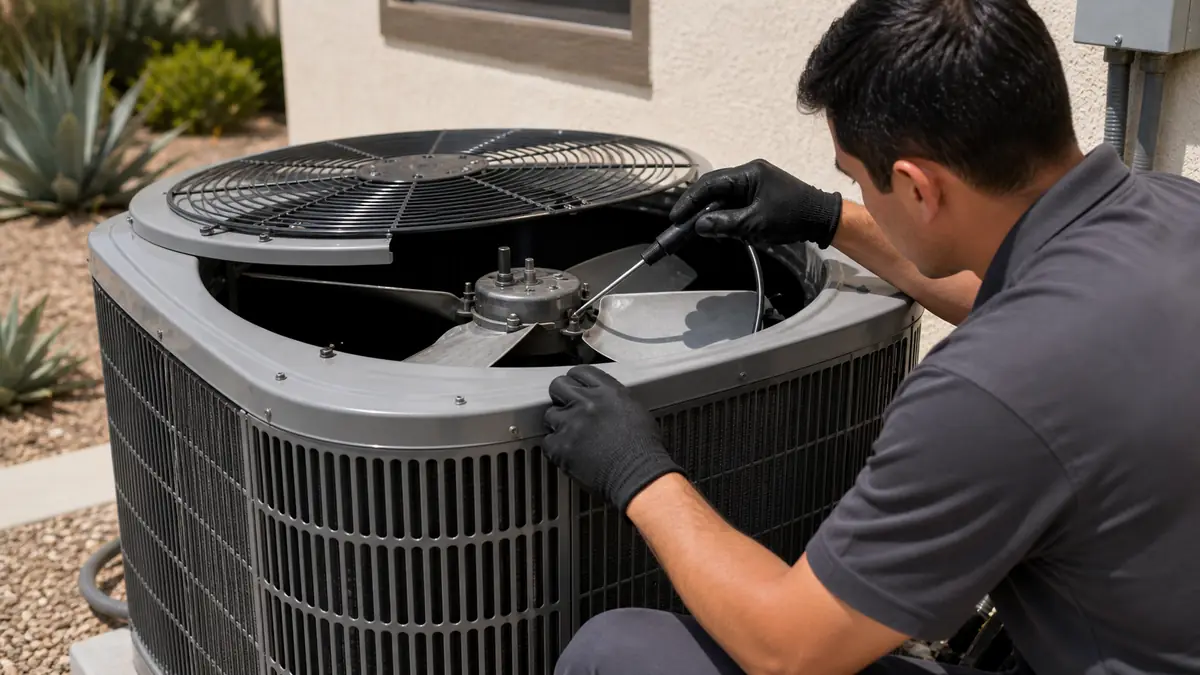
What does the U4 code mean on a Mitsubishi?
U4 is Mitsubishi Electric telling you that an outdoor thermistor - a temperature sensor on the outdoor condenser - is reading open or shorted, meaning its electrical circuit is broken or grounded out instead of returning a sensible resistance. Thermistors change resistance with temperature in a known curve, so the board constantly compares each sensor's reading to a valid range. When one falls outside that range, the board cannot trust the temperature it reports, so it throws U4 and protects itself. The U family of codes covers outdoor and inverter protection specifically, which is why this fault lives on the condenser, not the indoor head.
The outdoor unit carries several thermistors - typically an ambient sensor, an outdoor coil sensor, and on many models a discharge sensor - and any one of them can throw U4 if it fails open or shorted, or if its harness chafes through. The good news is that the most common causes are inexpensive: a single failed sensor or a pinched, sun-baked harness. The board itself is the rarest cause, even though it is the most expensive, which is exactly why the diagnosis matters more than the code.
Why does a Mitsubishi throw U4 in Glendale homes?
Glendale's setting is hard on outdoor sensors. The Verdugo Mountains and Verdugo Wash create localized hillside heat pockets that hold heat into the evening, and condensers tucked against slopes in Verdugo Woodlands and Glenoaks Canyon bake in that trapped heat for hours. Thermistor harnesses run along the outside of the unit and up the line set, and years of that heat plus UV degrade the wire insulation until a conductor chafes or a connector corrodes - and a corroded or open connection reads exactly like a failed sensor: U4.
Housing stock plays a part too. Many Spanish Colonial revival, Tudor, and Craftsman homes in Rossmoyne and Adams Hill were retrofitted with ductless systems, and the outdoor units often sit on side yards or rooftops with long, exposed sensor harness routing. Rodents and the occasional Verdugo critter chew exposed low-voltage wiring, and Santa Ana wind events drive grit into connectors. All of it shows up as a U4 even though the board is fine. Knowing the install age and where the condenser sits tells us where to look first.
How do you diagnose a Mitsubishi U4 code, step by step?
U4 is one of the more satisfying codes to diagnose because it is measurable, not a judgment call. We start by reading the stored code and any live sensor values from the board with a service tool, which often names which thermistor is out of range. Then we pull the suspect sensor's connector and measure its resistance with a multimeter, comparing the reading to Mitsubishi's resistance-versus-temperature chart for that sensor. An open circuit reads infinite resistance; a shorted sensor reads near zero; a sensor reading wildly off the chart for the actual outdoor temperature is failing.
If the sensor measures correctly at its connector, we move to the harness: we ohm the wire run end to end, flex it to catch an intermittent break, and inspect every connector for corrosion, melt, or a chewed jacket. Heat-baked harnesses in Glendale's foothill heat pockets are a frequent find here. Only when the sensor and harness both check out do we suspect the outdoor control or inverter board - and we confirm by substituting a known-good sensor and watching whether the live reading comes back into range. That order keeps a $40 sensor fault from turning into an unnecessary board sale.
What can I safely check myself before calling?
Two checks are safe for a homeowner with the power off at the disconnect or breaker. First, look at the outdoor unit's wiring where you can see it - the sensor harness running along the casing - for an obviously chewed, melted, or pinched wire, which after a Verdugo rodent visit is sometimes plainly visible. Second, clear leaves, seed pods, and grit from around the unit so nothing is abrading the harness. That is the safe limit. Do not open the electrical compartment, do not unplug sensors to test them, and do not probe the board: capacitors and inverter circuits hold dangerous voltage even with the power off, and a mis-seated connector can create a new fault.
Measuring thermistor resistance, ohming a harness, and confirming a board all need a multimeter, the model's resistance chart, and the training to interpret them. If the U4 returns after a power-cycle, or if the unit keeps tripping and stopping, that is the call-a-pro line. Forcing repeated restarts on a unit that cannot read its own temperature risks letting the inverter mis-control under load.
What does a U4 repair cost in Glendale, and when is it urgent?
Cost tracks the part, and U4 has a wide spread. A failed outdoor thermistor or a chafed sensor harness is the minor end - the sensor is inexpensive and the labor is moderate, so most U4 repairs land in the low hundreds. If the diagnosis points to the outdoor control or inverter board, the range jumps to about $400 to $2,000 depending on the model and board. Because that gap is so wide, the resistance measurements that name the part are the most valuable part of the visit; they are what keep a sensor fault from being quoted as a board.
Urgency is moderate. A U4 rarely fails dangerously, but a unit running on a sensor it cannot trust may mis-time defrost or mis-control the inverter, running inefficiently and stressing parts. If the unit still cools but logs an occasional U4, book a same-week diagnosis. If it trips to U4 and stops, or cycles repeatedly, shut it off and book sooner - repeated protection trips are the system telling you to stop forcing it. Call (213) 755-3565 or book online and we schedule across the 91201 to 91208 ZIPs.
Common questions
What does a U4 code mean on my Mitsubishi in Glendale?
A U4 means an outdoor thermistor is open or shorted - a temperature sensor on the outdoor unit, or its harness, is reading out of range. U-codes are outdoor and inverter protection trips, so the board is protecting itself from a sensor it cannot trust. It is often a cheap sensor or a chafed wire, not a board, but it must be measured to be sure.
Is it safe to run my Mitsubishi with a U4 code in Glendale?
Short term, a U4 is rarely dangerous, but do not run it for days. With a bad outdoor sensor the board cannot read coil or ambient temperature correctly, so it may mis-control defrost or the inverter and run inefficiently. If the unit keeps tripping to U4 and stopping, shut it off and book a diagnosis rather than forcing repeated restarts.
How much does a U4 repair cost in Glendale?
It depends on the part. A failed outdoor thermistor or a chafed sensor harness is the minor end - sensor and labor land in the low hundreds. If the fault is in the outdoor control or inverter board, the range runs about $400 to $2,000. We always meter the sensor and harness first, because replacing a board on a $40 sensor fault is the wrong call.
Can I clear a U4 code myself in Glendale?
You can power-cycle the unit at the breaker, and if the sensor is intermittent the code may briefly clear. But U4 reports a measurable condition - an open or shorted sensor circuit - so it comes back. Resetting hides it; it does not fix it. If the code returns within a cycle, stop resetting and call (213) 755-3565 so we can measure the sensor resistance.
Reference: the Mitsubishi error code hub and the related U2 high-discharge code. For service see AC repair.